
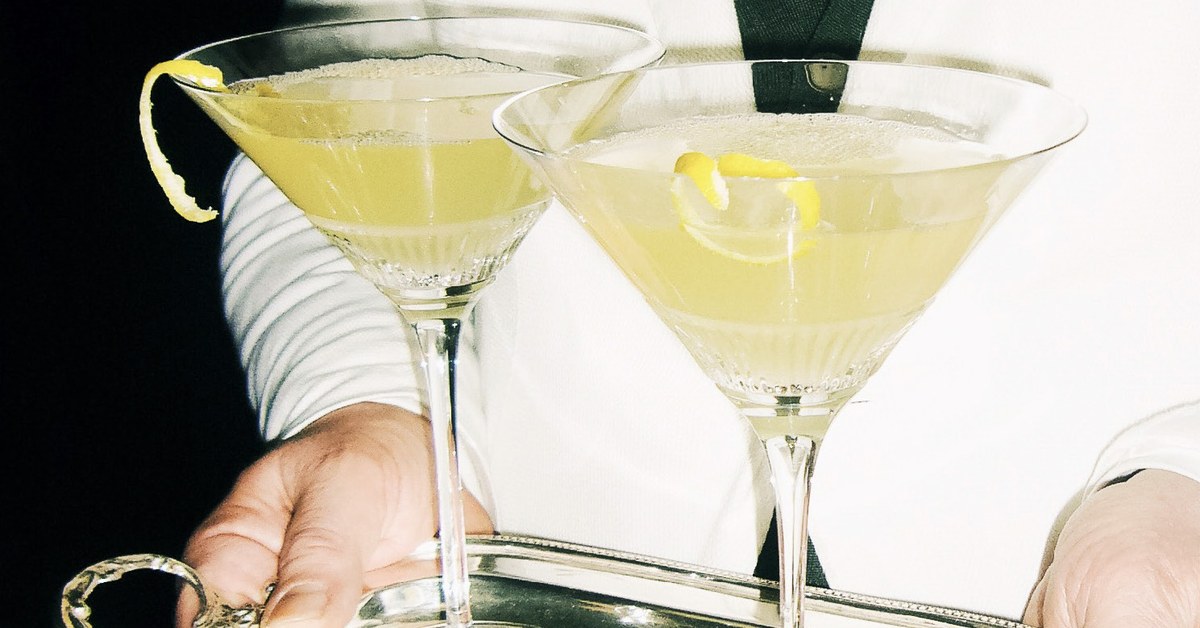
To throw a Great Gatsby party, take your cue from Chapter III of F. Scott Fitzgerald's novel: a band, a bar, a buffet, a great many lights, Champagne and gin cocktails going around on trays, and guests in evening clothes until well past midnight. At home that comes down to a formal invitation, a clear dress code (black tie, or 1920s), jazz from the decade itself, food guests can eat standing up, two or three gin drinks planned in advance, and a toast.
Below: the party as Fitzgerald wrote it, then the invitation, the dress code, the music, the food, a plan for the bar, and a New Year's Eve version built around the midnight toast.
| In the novel | At yours | |
|---|---|---|
| Invitation | A "surprisingly formal note" asking Nick to Gatsby's "little party" | A written invitation with the hour, the place and the dress code |
| Music | An orchestra of "oboes and trombones and saxophones" | Jazz of the 1920s, live or on a playlist |
| Bar | "a bar with a real brass rail" | A counter or cart with gin, vermouth, lemons, limes and Champagne on ice |
| Food | "spiced baked hams" and "salads of harlequin designs" | A standing buffet, then a second round after midnight |
| Light | Colored lights "to make a Christmas tree of Gatsby's enormous garden" | String lights and candles, overhead lights off |
| Dress | Nick in "white flannels," guests with "hair bobbed in strange new ways" | Black tie, or 1920s evening dress |
What was a Gatsby party like in the novel?
Fitzgerald set The Great Gatsby on Long Island in the summer of 1922, and Chapter III opens on the parties next door to the narrator, Nick Carraway. "In his blue gardens men and girls came and went like moths among the whisperings and the champagne and the stars." Quotations here are from the Project Gutenberg edition of the novel.
The machinery behind it was enormous. Every Friday five crates of oranges and lemons arrived from New York, and on Monday they left the back door "in a pyramid of pulpless halves." A machine in the kitchen could "extract the juice of two hundred oranges in half an hour." At least once a fortnight the caterers came with "several hundred feet of canvas" and enough colored lights "to make a Christmas tree of Gatsby's enormous garden."
Then the table and the bar: "On buffet tables, garnished with glistening hors-d'oeuvre, spiced baked hams crowded against salads of harlequin designs and pastry pigs and turkeys bewitched to a dark gold. In the main hall a bar with a real brass rail was set up, and stocked with gins and liquors and with cordials so long forgotten that most of his female guests were too young to know one from another."
And the music: "By seven o'clock the orchestra has arrived, no thin five-piece affair, but a whole pitful of oboes and trombones and saxophones and viols and cornets and piccolos, and low and high drums." Soon "floating rounds of cocktails permeate the garden outside," the orchestra is "playing yellow cocktail music," and champagne is "served in glasses bigger than finger-bowls." There are two suppers, the second after midnight, and by then "the hilarity had increased. A celebrated tenor had sung in Italian, and a notorious contralto had sung in jazz."
Who came to Gatsby's parties?
Almost anyone. Nick believes he was "one of the few guests who had actually been invited." The rest drove out from New York, were introduced by somebody who knew Gatsby, and sometimes left without meeting him at all; they "came for the party with a simplicity of heart that was its own ticket of admission." In Chapter IV Nick writes their names on the empty spaces of an old railroad timetable, dated July 5th, 1922.
How long did a Gatsby party last?
From early evening into the small hours. The orchestra was there by seven, the second supper came after midnight, and Gatsby's car ferried guests to and from the city "between nine in the morning and long past midnight." Nick leaves his first party "among the last to go." Gatsby himself stays apart: Nick wonders "if the fact that he was not drinking helped to set him off from his guests."
How to throw a Great Gatsby party at home
Gatsby had caterers and an orchestra. A party at home needs the same six things on a smaller scale: an invitation, a dress code, music, food, a bar and the right light. Turn the overhead lights off and let string lights and candles stand in for the colored lights in Gatsby's garden.
The invitation
Borrow Gatsby's tone: formal, a little grand, and clear about the hour. For example: "The pleasure would be entirely ours if you would attend our little party on Saturday, December 12, at eight o'clock. Black tie." Add the address, a reply-by date and, if there is one, an end time.
What to wear to a Great Gatsby party: black tie or 1920s?
Say which on the invitation, because the two ask for different things. Black tie means a tuxedo, or dinner jacket, with a black bow tie for men, and an evening gown or other evening wear for women, as Wikipedia's entry on black tie sets out. In the 1920s even the dinner jacket had a fashion of its own: notch lapels, borrowed from the business suit, were a brief vogue.
1920s dress, or Jazz Age attire, invites period clothes: for women, the knee-length hem and bobbed hair of the flapper; for men, a dinner jacket or a light suit (Nick goes to his first Gatsby party in "white flannels"). "Black tie, 1920s welcome" on the invitation lets each guest choose between the two.
What music to play at a Gatsby party
Jazz from the decade itself. Swing belongs to the 1930s; the Jazz Age ran from 1920 into the early 1930s and ended before the swing era, as Wikipedia's entry on the Jazz Age puts it. A good evening uses several kinds:
- Dance orchestras for arrival and dinner. Paul Whiteman was the most popular bandleader in the country by the mid-1920s, and his orchestra premiered Gershwin's Rhapsody in Blue in 1924.
- Hot jazz for the dancing hours, with Chicago as its center: King Oliver, Louis Armstrong's Hot Five, Bix Beiderbecke's Wolverines (1924) and Jelly Roll Morton's Red Hot Peppers (1926).
- The songs in the novel. Fitzgerald names real ones: "The Sheik of Araby" and "Ain't We Got Fun?", both from 1921, and W.C. Handy's "Beale Street Blues" from 1917.
- A waltz to close. Daisy hears "Three O'Clock in the Morning," "a neat, sad little waltz of that year," drifting out of Gatsby's door. Paul Whiteman's 1922 recording of it sold more than a million copies, according to Wikipedia's entry on the song.
A live trio is the grand version; a playlist built from those names does the job.
Great Gatsby party food
Gatsby served hors d'oeuvres, spiced baked hams, salads "of harlequin designs," pastry pigs and turkeys, and a second supper after midnight. At home, serve what guests can eat standing with a glass in the other hand: a glazed ham sliced thin with small rolls and mustard, a bright composed salad, small savory pastries, and a bowl of oranges, lemons and limes that doubles as decoration and as the bar's supply. Then follow Gatsby and bring out a second, warmer round after midnight: scrambled eggs, toasted sandwiches, a pot of coffee.
Great Gatsby party drinks: a plan for the bar
Gatsby's bar was stocked with "gins and liquors," and the cocktails came around on trays. At home, choose two or three drinks, prepare what you can before the doorbell rings, and set out the rest so guests can help themselves. Four that fit the decade, all with gin:
French 75
Gin, fresh lemon juice and sugar syrup, shaken, strained into a flute or coupe and topped with Champagne. The drink took its name and its modern recipe in the 1920s; a 1927 drinks book printed it as gin, sugar, lemon juice and Champagne, according to Wikipedia's entry on the French 75. It puts the novel's two drinks, Champagne and gin, in one glass. Mix the gin, lemon and syrup by the pitcher before guests arrive, keep it cold, and top each glass to order.
Gin rickey
Gin, the juice of half a lime and soda water over ice, with little or no sugar. On the warmest day of the summer, in Chapter VII, Tom Buchanan comes back into the room "preceding four gin rickeys that clicked full of ice." It is the easiest drink here to make by the dozen; more gin highballs are in what to mix with gin.
Bee's Knees
Gin, honey syrup and fresh lemon juice, shaken hard. "The bee's knees" was flapper slang for a superb person, and the cocktail with that name is a Prohibition-era drink. Our version is called The Daisy.
Martini
Gin and dry vermouth stirred very cold and finished with a twist of lemon, for guests who would rather sip than toast. How much vermouth makes it dry is in what is vermouth.
The house versions of the French 75, the Daisy and the martini are on our cocktails page. For quantities, a 750 ml bottle of gin holds 25.4 fluid ounces, about 17 drinks at 1½ ounces each, as worked out in how many ounces in a shot, and at 3 to 4 ounces a glass a bottle of Champagne tops six to eight French 75s. For a dinner party later in the month, see Thanksgiving gin cocktails.
Put water out next to the bar, keep food coming all night, offer a lime rickey, the same drink without the gin, to anyone not drinking, and make sure every guest has a safe ride home. Gatsby, Fitzgerald tells us, "formed the habit of letting liquor alone"; the host who keeps a clear head is in good company.
A Great Gatsby New Year's Eve party
New Year's Eve already asks for evening dress, music and Champagne at midnight. Keep everything above and build the last hour around the toast.
- At a quarter to midnight, set coupes or flutes out on trays and bring the French 75 base from the fridge.
- In the last five minutes, pour the gin mixture and top each glass with Champagne, so every glass is full and still fizzing on the stroke of twelve.
- At midnight, count down, raise a glass, and play "Auld Lang Syne," the Robert Burns song traditionally sung to see out the old year, as Wikipedia's entry on it notes.
- After midnight, do what Gatsby did and serve the second supper.
The name on our bottle is Gatsby, and it is at home at this party. Gatsby Gin is a London Dry gin of ten botanicals, made in small batches in a copper pot still in Fort Myers, Florida, and it is the gin in every house cocktail named above, from the French 75 to the Daisy. What makes a gin London Dry is set out in what is London Dry gin.
Frequently asked questions about Great Gatsby parties
What is a Great Gatsby party?
A party themed on the lavish parties in F. Scott Fitzgerald's 1925 novel The Great Gatsby, set in the summer of 1922. It usually means evening dress, 1920s jazz, Champagne and gin cocktails, and a late night.
What do you wear to a Great Gatsby themed party?
Whatever the invitation asks for. Black tie means a tuxedo or dinner jacket for men and an evening gown for women; 1920s dress means period clothes, such as a knee-length dress and bobbed hair, or a dinner jacket or light suit.
What food was at Gatsby's party?
In Chapter III of the novel: hors d'oeuvres, spiced baked hams, salads "of harlequin designs," pastry pigs and turkeys, and two suppers, the second after midnight.
What drinks were served at Gatsby's parties?
Champagne, served "in glasses bigger than finger-bowls," and cocktails from a bar stocked with "gins and liquors" and old cordials. Elsewhere in the novel the characters drink gin rickeys and a mint julep.
What music was played at Gatsby's parties?
Jazz from a full orchestra, with banjos on the lawn and singers in Italian and in jazz. The novel also names real songs of the day, including "The Sheik of Araby," "Ain't We Got Fun?," "Three O'Clock in the Morning" and "Beale Street Blues."
How long did Gatsby's parties last?
From about seven in the evening until long past midnight. The orchestra arrived by seven, and the second supper was served after midnight.
Who attended Gatsby's parties?
Mostly people who were never invited. Nick Carraway says he was one of the few invited guests; the rest drove out from New York and simply came.
How do you host a Great Gatsby New Year's Eve party?
Plan the evening around the midnight toast: set out coupes, pour French 75s or Champagne in the last minutes before twelve, and serve a second supper after midnight, as Gatsby did.